Example schedule#
SHADOW is Workflow-oriented, which means most of the work done within the library involves passing around workflow objects, or storing data within the object itself.
This workflows are represented as Directed Acyclic Graphs (DAGs), and the a solution to the DAG scheduling problem is the scheduling order and machine allocation of tasks (the nodes) from the DAG.
In SHADOW, we use JSON to store our workflows, which are always represented
as DAGs. This JSON data is read into a SHADOW as a NetworkX DiGraph
object, and then wrapped in SHADOW’s Workflow class. The Workflow
class accepts two types of graph specifications; one that has pre-calculated
costs, and one without. The preferred approach is to present task with ‘total
computation cost’; the units may be application specific, but when coupled
with machine resources they should be easily converted to time (it is easiest
to think of them in terms of required cycles or Total FLOP).
For exampe, below is a small workflow, depicted as a graph, with the total computation costs and machine values stored in the table to the right. The workflow is based on the example presented in the HEFT paper 1.
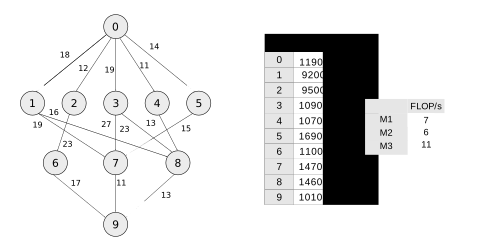
The computation costs for tasks, along with the graph attributes, are stored
in a JSON file separate to the machine specifications. In SHADOW, we first
initialise a Workflow object, and then add an environment to it; this
environment is constructed from our machine specification. The
structure of the specification files are described in more detail in
‘Configuration’.
from shadow.classes.workflow import Workflow
from shadow.classes.environment import Environment


wf = Workflow('example_graph.json')
env = Environment('machine_spec.json')
wf.add(env)
To run an algorithm on the workflow and determine the final makespan, simply pass the Workflow object to the algorithm:
from shadow.heuristics import heft


heft(wf)
print(wf.makespan) # 98